
London GardenMusic StudiosLondon Garden Music Studios

Garden Music Production Studios

Garden production and mixing studios designed around accurate monitoring, room proportions and quiet evening working.

Discuss your studio
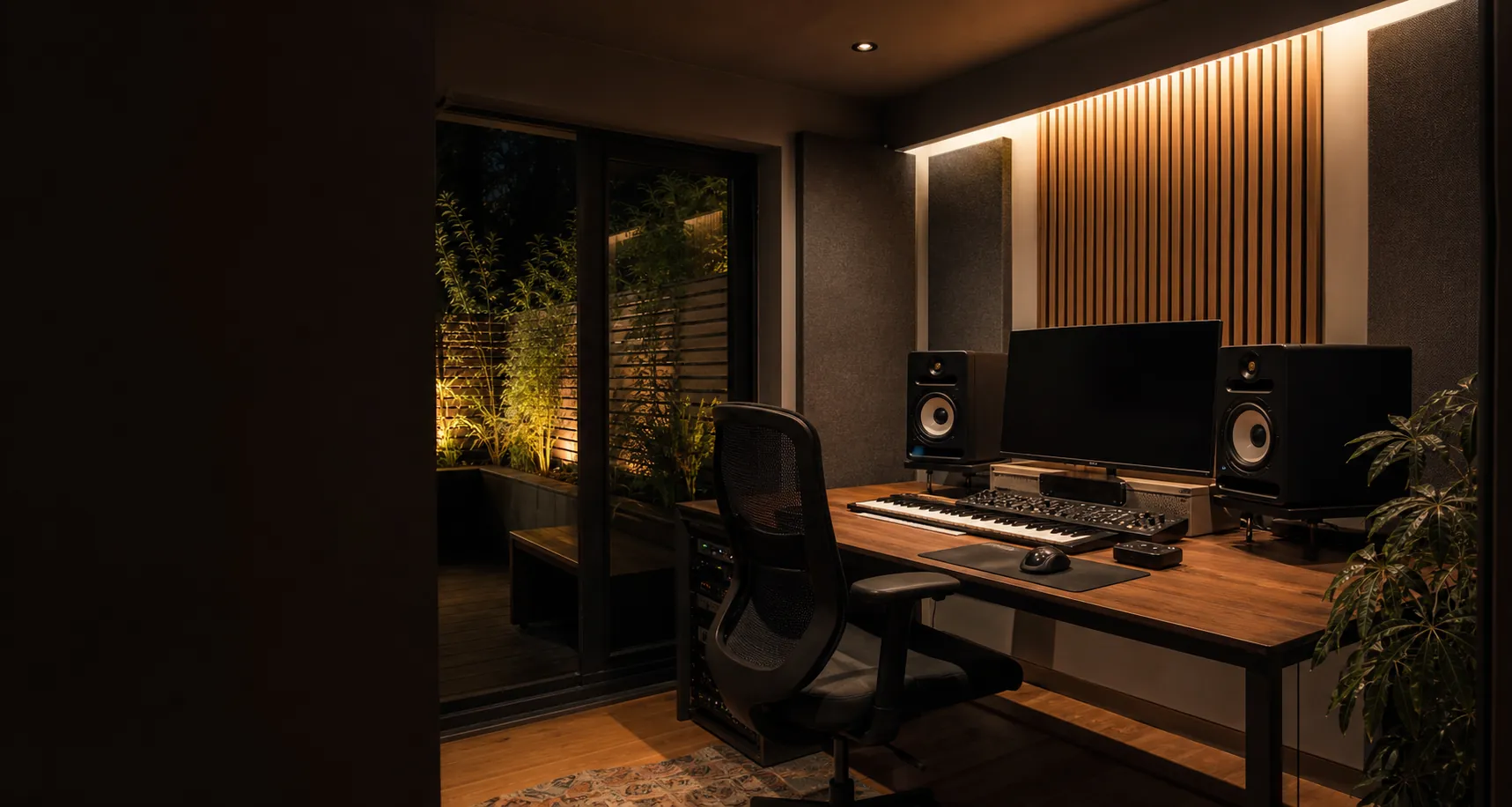
A purpose-built garden production studio with monitors, keyboard and mixing desk

A garden production studio is built around one central problem that a practice room or even a recording room doesn't have to solve: can you trust what you're hearing. Tracking a good take depends mainly on capturing clean audio, but mixing and producing depend on the room telling the truth about frequency balance, stereo image and low end, which makes room shape and treatment as important as isolation.

Producers also tend to work at different hours than a household runs on, late evenings, sometimes into the night, which puts extra weight on containing what the room puts out rather than only what it lets in. A recording focused build and a production studio share a lot of construction, but the design priorities inside the room are different.

This page covers what actually matters for a production or mixing room: monitoring accuracy, room proportions, equipment and storage, and what changes about working in a London garden rather than a rural one.

The acoustic challenge

A production studio lives or dies on whether you can trust what you hear at the mix position, which depends as much on room proportions and treatment as on isolation. It still has to solve the same two way noise problem as any garden studio, especially for anyone working, or wanting to work, into the evening.

Understand acoustic performance
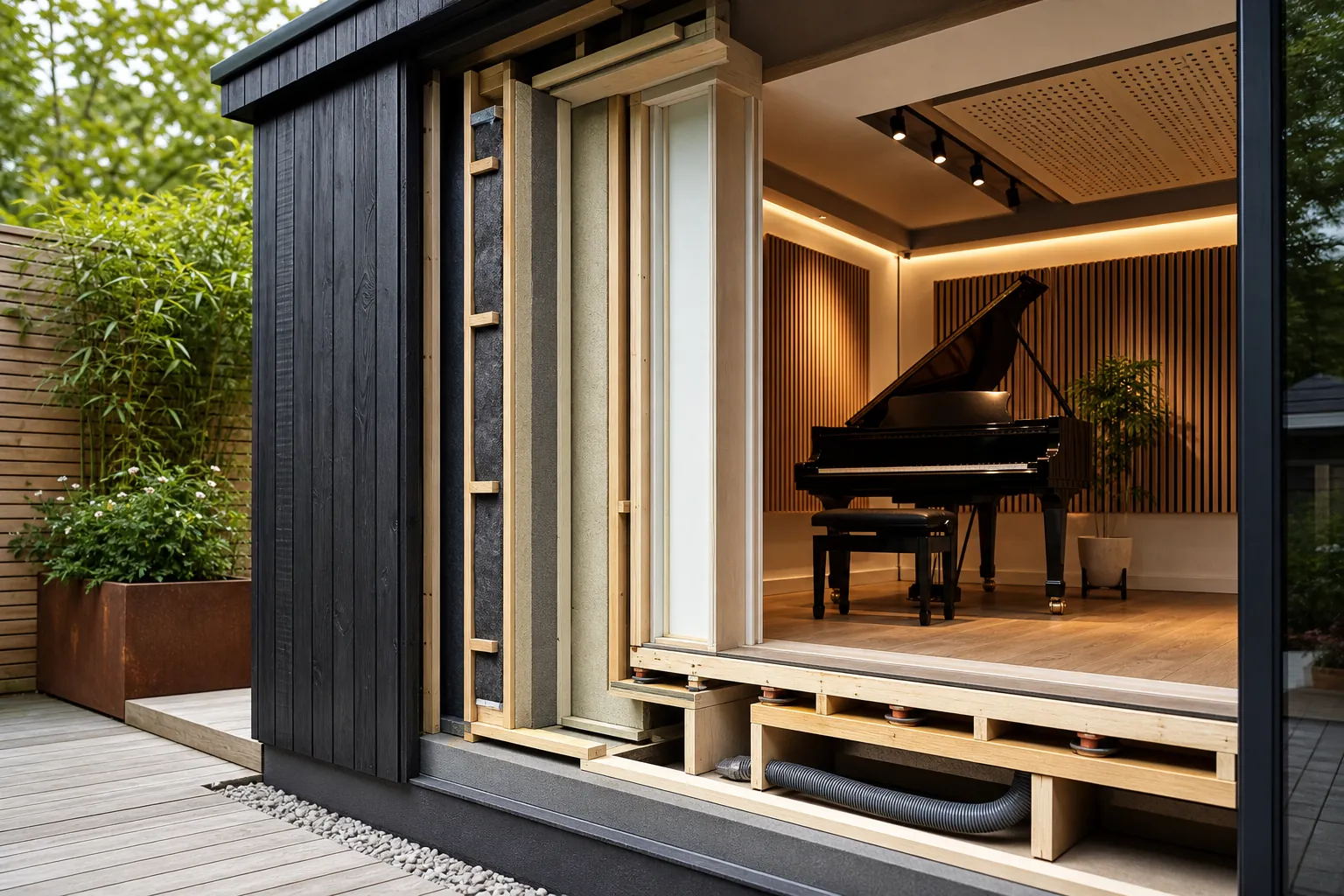
Cutaway view showing the independent inner structure of a soundproof garden studio

What a Production Studio Has to Get Right

A production studio is mostly a computer based workflow: a desk, monitors, an audio interface, racks or outboard gear, and a listening position that has to stay consistent every time you sit down. Unlike a live tracking room, it doesn't need to flatter a performance, it needs to disappear, so that decisions made on the mix translate properly to headphones, a car stereo or a client's own speakers.

That makes the room itself part of the instrument in a way a practice space isn't. A poorly proportioned room will lie about the low end specifically, boosting or cancelling certain bass frequencies depending on where you sit, which is a common reason home mixes translate badly elsewhere.

Why Monitoring Accuracy Is the Real Design Problem

Small rooms are prone to room modes, resonances at specific frequencies set by the room's dimensions, and the effect is worst in exactly the range most mixing decisions get made in, the low end. Getting the proportions right at the design stage, rather than trying to treat the problem away afterwards, is the difference between a room that needs careful checking against other systems and one you can broadly trust.

Isolation still matters alongside all of that. Keeping outside noise out protects the accuracy of what you hear at the mix position just as much as it protects the neighbours from what you're playing back, and both directions need to be part of the same design rather than treated as separate problems.

Room Shape, Size and Layout for a Mix Position

Proportions matter more here than in almost any other studio type. Square rooms and rooms with simple whole number ratios between length, width and height concentrate resonances at the same frequencies and are generally avoided in favour of less regular proportions. The mix position itself needs real distance from the front wall and from the monitors, and ideally a symmetrical layout either side of the listening spot, which uses more of the room's footprint than people often plan for.

Storage and equipment also need planning in early rather than squeezed in afterwards: synths, outboard, a patchbay, cabling and a growing collection of gear all want a home that doesn't compromise the listening position once it's built. A room sized purely on floor area, without factoring in equipment and cable runs, is a common reason producers outgrow a build within a couple of years.

Producing Late in a London Garden

Working evenings and into the night is normal for a lot of production and mixing work, which makes containment as important as monitoring accuracy. A build that keeps the room quiet for you but leaks bass through a thin wall or a poorly sealed door late at night creates exactly the kind of complaint that ends up with the council rather than staying between neighbours.

The same flats rule applies here as any garden building: flats and maisonettes have no permitted development rights for outbuildings, so a production studio at a flat needs a full planning application regardless of size or use. Detached and semi detached houses usually have more flexibility, but boundary proximity in a typical London garden still shapes the design.

What Shapes the Cost of a Production Grade Build

Cost here follows the same drivers as any garden studio, size, isolation level, access and finish, with a couple of production specific additions: careful room proportioning at the design stage, and often quieter running ventilation or cooling, since computers and outboard generate heat that a sealed room needs to manage without introducing fan noise into a critical listening space.

Getting the room proportions and layout right from the outset avoids expensive retrofitting later. Request a studio assessment and describe your setup, your equipment and your garden, and we'll give you a realistic view of what's achievable.

Common questions

The practical details people usually need before deciding whether a garden studio is viable.

What size room do you need for music production?

There's no fixed minimum, but the mix position needs genuine distance from the monitors and the front wall, which tends to rule out very small or awkwardly proportioned rooms. Most workable production rooms end up needing more floor area than people expect once that distance and equipment storage are factored in.

Do I need acoustic treatment as well as soundproofing for a production studio?

Yes, they solve different problems. Soundproofing controls what gets in and out of the room, while acoustic treatment controls how the room itself sounds once you're inside it, and a production space needs both to give an accurate monitoring environment.

Can I work in a garden production studio at night without disturbing neighbours?

That's the aim of the build, but it depends on the isolation specified for the room and how loud you're monitoring, particularly at low frequencies which travel furthest. It's worth flagging evening or night use as part of the brief so the design accounts for it directly.

What is the ideal room shape for a mixing studio?

Square rooms and simple whole number ratios between the dimensions are generally avoided because they concentrate resonances at the same frequencies. Beyond that, the right proportions depend on the room's overall size and the mix position within it, which is a design decision rather than a fixed formula.

Can a garden production studio fit synths, racks and a full computer setup?

Yes, but it needs planning in from the start rather than added after the room is built. Storage, cabling and equipment placement all affect the usable footprint around the mix position, so it's worth listing your full setup at the design stage.

Make the room fit the work.

Tell us what you want to record, how you work, and what your garden allows. We’ll start with the constraints that actually shape the room.

Request an assessment