
London GardenMusic StudiosLondon Garden Music Studios

Garden Recording Studios

Purpose built garden recording studios for tracking vocals and instruments at home, isolated from the street in both directions.

Discuss your studio
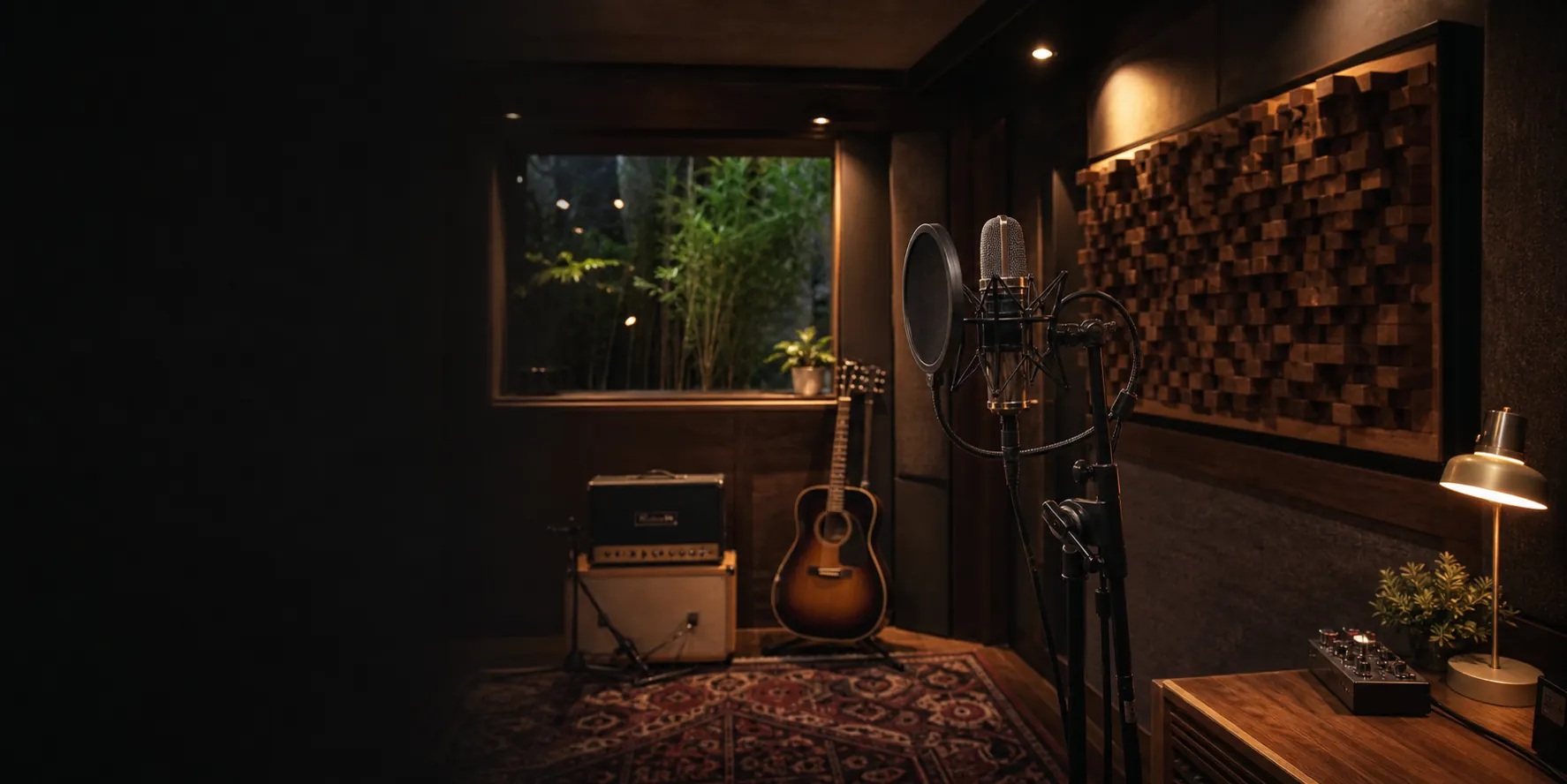
A garden recording room arranged with a vocal microphone, guitar and amplifier

A garden recording studio exists to get a clean take at home: vocals, guitar, a full band or anything in between, captured without the background of a London street bleeding into the recording. That's a different, harder brief than a practice room, because a person in the room filters out a passing car without noticing it, while an open microphone captures it at full level.

The building has to work in both directions. It has to keep external noise out of the microphone, and it has to contain whatever's being recorded, a loud vocal take, a cranked amp, a full kit, so it doesn't become the neighbours' problem. Getting one direction right and ignoring the other is the most common reason a home recording setup underperforms.

This page sets out how we think about that brief: noise floor, the difference between a live space and a control room, and what changes when the build is in a London garden rather than open countryside.

The acoustic challenge

A recording studio has a harder acoustic target than a practice room, because a microphone hears far more than a person standing in the same spot. It has to keep external noise, traffic, aircraft, next door's garden, below the level a sensitive mic will pick up, while still containing whatever's being tracked inside.

Understand acoustic performance
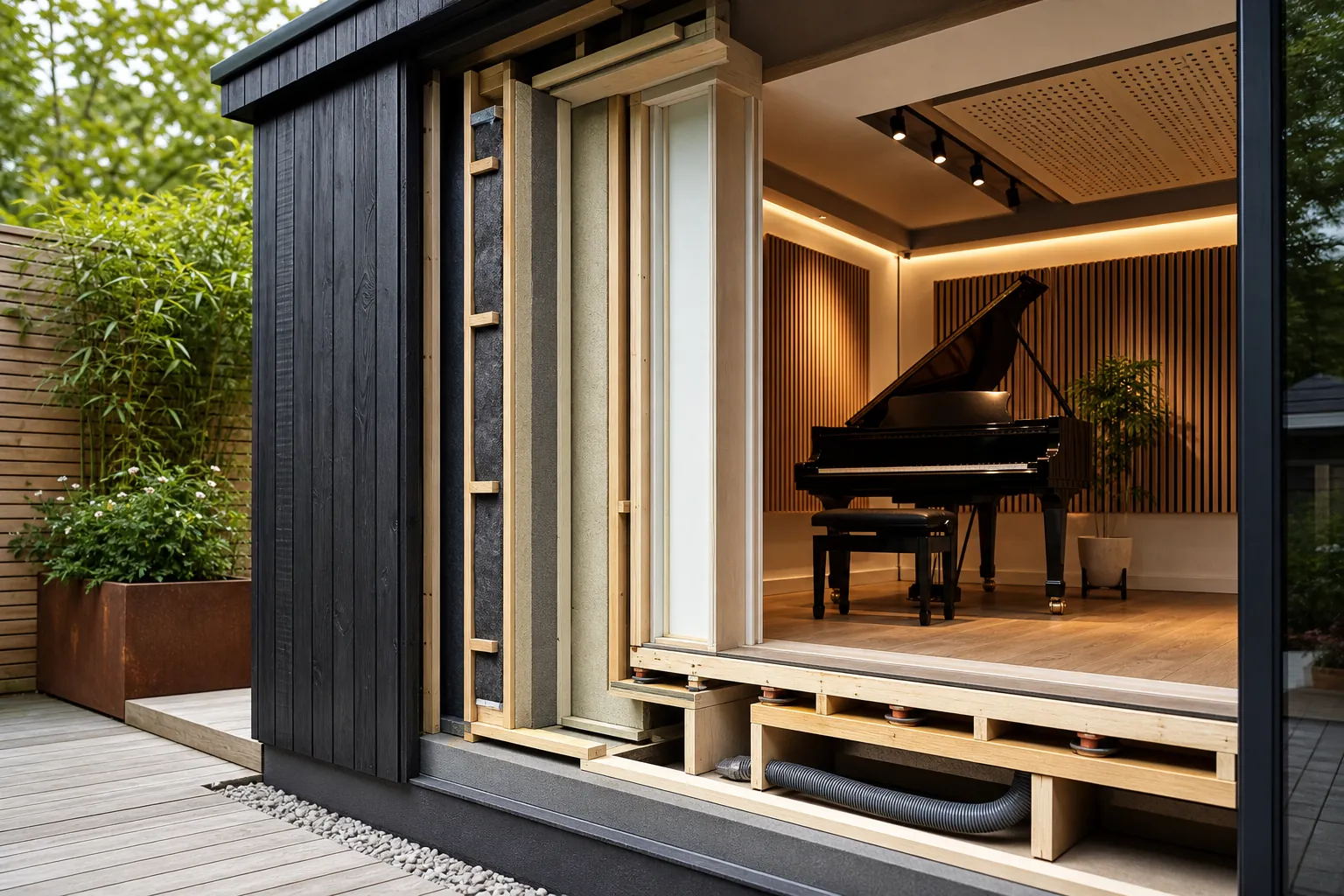
Cutaway view showing the independent inner structure of a soundproof garden studio

What a Garden Recording Studio Has to Achieve

The starting question for a recording build is different from a practice room: not just how loud can this get, but how quiet does the room need to be before you can hear the noise floor at all. A microphone placed close to a vocalist will pick up a boiler, a fridge, a fan or a passing van long before a listener in the room notices any of them.

That's why a genuine recording room is specified around the quietest thing you plan to capture, a close whispered vocal or a quiet acoustic passage, rather than the loudest. Get that right and louder sources, drums, amps, a full band, are the easier problem to solve afterwards.

Why a Microphone Hears More Than You Do

Traffic, aircraft on a flight path, a neighbour's extractor fan, rain on a roof and general garden noise, foxes, bins, next door's mower, all sit below conscious hearing for most people but show up clearly on a recording once the gain is up. Isolating against all of it means treating the building envelope as a whole, wall build up, glazing, doors, ventilation and roof, not just the wall panels people usually picture.

Ventilation is the part that catches people out. A sealed room needs air movement to stay usable, but a standard extractor fan or trickle vent is a direct route for outside noise straight past an otherwise well built wall. A recording studio needs ventilation designed specifically not to undo the isolation everywhere else, which is a specialist detail rather than an afterthought.

Control Room and Live Space Thinking in One Small Building

Commercial studios separate a live room, where the sound is made, from a control room, where it's monitored and mixed, because the two need different acoustic behaviour: a live space can take some character, a control room needs to be accurate and controlled. Most garden builds don't have room for two fully separate spaces, so the thinking has to be scaled down rather than abandoned.

In a single room build, that usually means treating one end for capture and keeping the monitoring position and speaker placement deliberate rather than an afterthought, so what you hear back while recording stays close to what you actually captured. Where the garden and budget allow a genuine two room split, tracking and a proper mix position in separate spaces gives a cleaner result, closer to how a commercial studio is laid out.

Recording in a London Garden

Access matters more for a recording build than most garden projects, because the acoustic build up, multiple layers of dense board, mineral wool, an independent inner frame, is heavier and bulkier to get through a side gate than a standard garden room kit.

Planning follows the same rules as any garden building, with one exception worth knowing early: flats and maisonettes have no permitted development rights for outbuildings, so a recording studio at a flat needs a full planning application regardless of size. Detached houses with a garden usually have more flexibility, but boundary distances and coverage limits still apply.

What Drives the Cost of a Recording Grade Build

A recording studio costs more than an equivalent sized garden room mainly because of what's inside the walls rather than what's visible: the extra mass, the decoupled inner structure, acoustic glazing and doors, and ventilation designed not to leak sound. A single room build and a two room tracking and control setup sit at different points on that scale before size even comes into it.

Timelines vary with design complexity, the planning route and the season, so it's worth talking through your brief early. Request a studio assessment and we'll give you a realistic view of what a recording focused build involves for your garden.

Common questions

The practical details people usually need before deciding whether a garden studio is viable.

Can you build a proper recording studio in a garden?

Yes, with the right acoustic build up a garden building can reach a genuine recording standard, though the specification needed is higher than for a general practice room. The result depends on the property, the intended use and the level of isolation the design targets, so it's assessed case by case rather than guaranteed as a fixed outcome.

How do you stop traffic noise getting into a garden recording studio?

Mainly through mass and decoupling: a heavy, airtight outer shell and an independent inner structure that doesn't touch it, so vibration can't bridge across. Glazing, doors and ventilation are specified to match, since a gap in any one of them undoes a lot of the work done elsewhere.

Do I need a separate control room in a garden recording studio?

Not necessarily. A single well designed room can work for both tracking and monitoring in a smaller build, but a genuine two room split gives cleaner separation between the space where sound is made and the space where it's judged, if the garden and budget allow it.

Will a garden recording studio pick up rain and aircraft noise?

Both are common concerns and both can be designed against, though a lightweight roof build is usually the weakest point for rain noise specifically. It's worth flagging your local flight path or a busy road as part of the brief so the design can address it directly rather than as an afterthought.

How long does it take to build a garden recording studio?

It varies with design complexity, the planning route required and the time of year, so there's no fixed timeline that applies to every project. A straightforward permitted development build is generally quicker than one needing a full planning application, such as at a flat.

Make the room fit the work.

Tell us what you want to record, how you work, and what your garden allows. We’ll start with the constraints that actually shape the room.

Request an assessment