
London GardenMusic StudiosLondon Garden Music Studios

Soundproof Garden Rooms

Acoustic grade garden rooms built for real sound separation, not just insulation, for music, listening, loud hobbies or a quiet retreat.

Discuss your studio
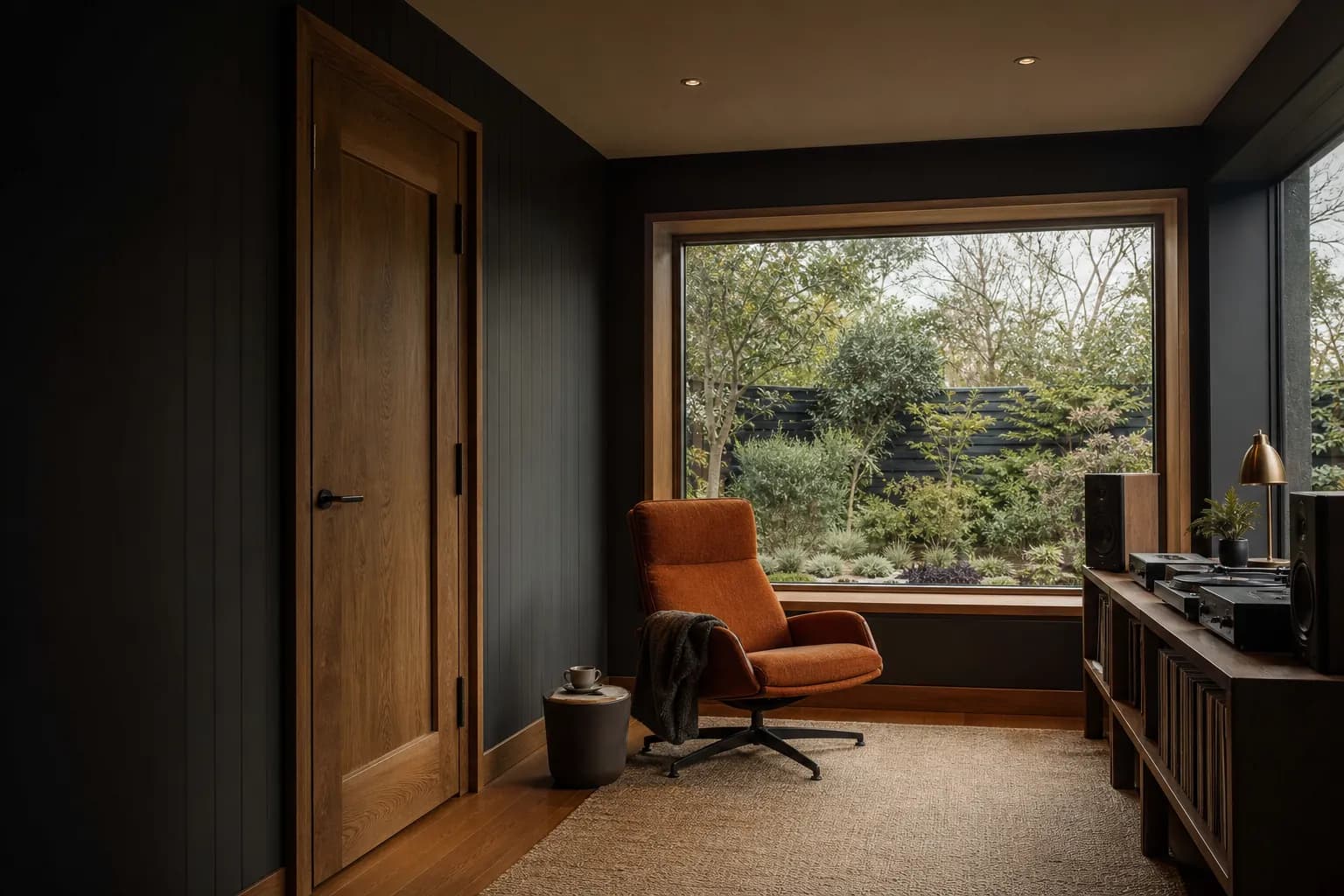
A calm soundproof garden room with a deep acoustic door and listening chair

Soundproof garden room is the term most people search, whatever they actually plan to use the room for, and it usually means something more specific than the default specification a garden room company quotes. Thermal insulation and acoustic isolation solve different problems: one manages heat, the other manages vibration and airborne sound, and a room can be well insulated in the first sense while doing almost nothing in the second.

The uses behind that search go well beyond music. People want a space to listen to a proper stereo system without disturbing the house, somewhere loud hobbies, woodworking, a home gym, a drum kit, can run without becoming next door's problem, or simply a room quiet enough to escape a noisy household for an hour. A garden music studio is one version of the same underlying build.

This page covers what acoustic grade construction actually changes compared with a standard garden room, and what to expect if you're building one in a London garden.

The acoustic challenge

Most people searching for a soundproof garden room actually want two different things at once: a room that stops sound leaking out to neighbours and the street, and a room that stops the outside world getting in. Standard garden room insulation, chosen for temperature, does very little for either.

Understand acoustic performance
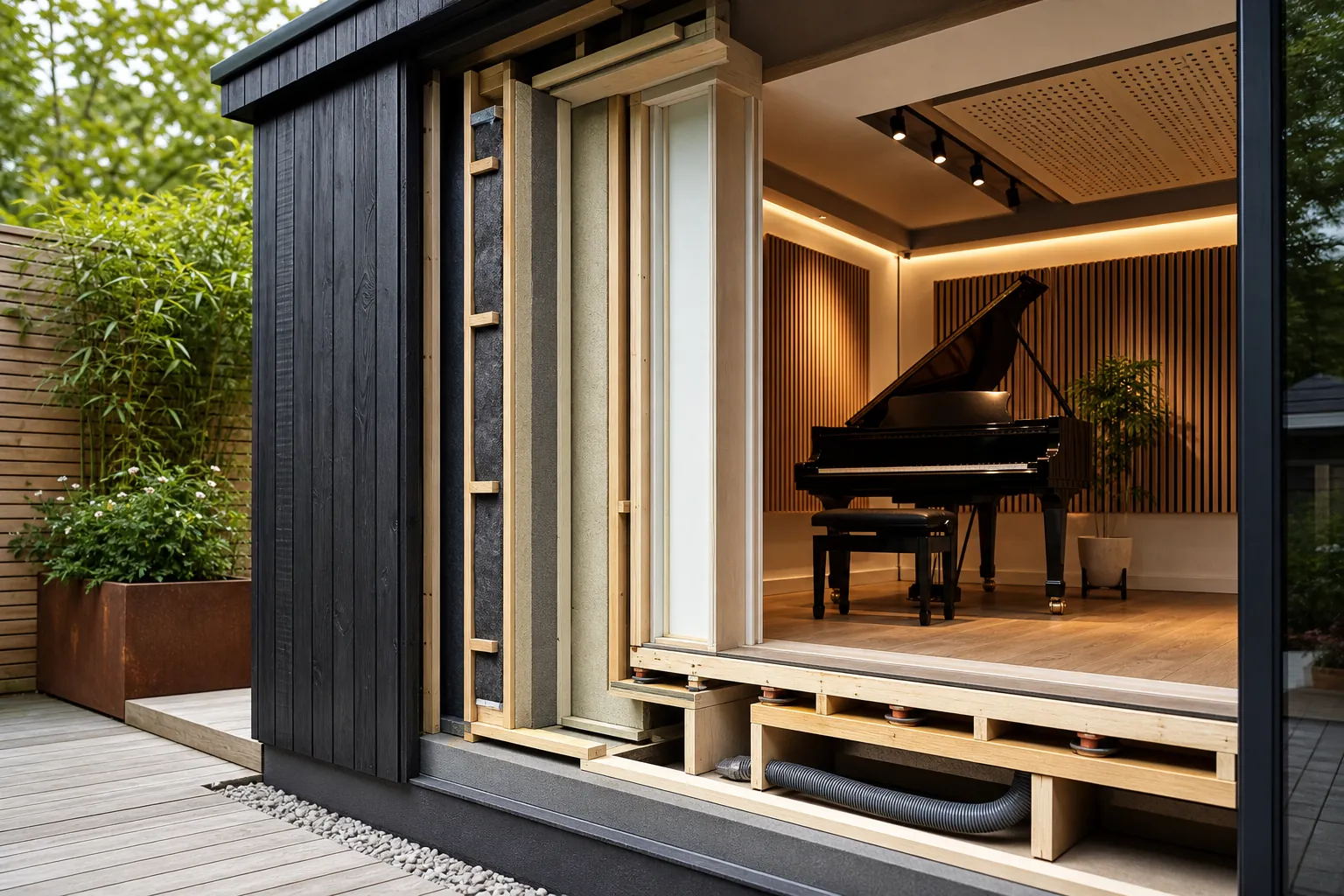
Cutaway view showing the independent inner structure of a soundproof garden studio

What People Mean by Soundproof

In everyday use, soundproof gets applied to almost any garden room that's a bit quieter than the shed it replaced. In a genuine acoustic build, it means a specific design intent: a target for how much sound has to stay in, how much has to stay out, and at which frequencies, decided before construction starts rather than added afterwards as an upgrade.

That distinction matters because the fixes are different. A room that's merely well insulated can often be improved with better seals and heavier glazing. A room that was never designed around an acoustic target usually needs structural changes, an independent inner leaf, added mass, proper isolation at the floor, to get close to what people picture when they search for the term.

Where a Standard Insulated Garden Room Falls Short

A standard garden room's insulation, typically a layer of rigid foam or mineral wool in the wall build up, is chosen to hold heat, and it does that well. It does very little to stop sound, because sound isn't just about how well a material traps warm air, it's about mass, stiffness and how rigidly one surface is connected to another. A light, well insulated wall can still transmit a surprising amount of sound simply because it's light and rigid.

Acoustic grade construction changes several things at once: added mass on both faces of the wall, an inner structure that isn't rigidly fixed to the outer shell, sealed rather than just filled junctions, and glazing and doors specified for sound rather than just weather. The full specification is chosen against the target for that particular room, not applied as a flat upgrade across every project.

Other Uses Beyond Music

Music is one driver, but far from the only one. Audiophiles and home cinema enthusiasts want a room where a proper sound system can be pushed without an argument through the wall. People with loud equipment or hobbies, power tools, a home gym, a drum kit that isn't even the main use of the room, want the same isolation without the music framing. Some clients simply want a quiet room to work, read or make a call away from a busy household, which needs the acoustic build up in reverse: keeping the house's noise out rather than the room's noise in.

The construction approach barely changes between these uses. What changes is the balance point: a listening room cares most about keeping outside noise out at low levels, while a room for loud equipment cares most about containing peaks. That balance is a design conversation, not a fixed spec sheet.

Soundproofing a Garden Room in London

London gardens are usually smaller and closer to a boundary than the sites acoustic garden room marketing tends to show, which puts more pressure on getting the design right first time rather than adding treatment later. Terraced and semi detached houses in particular mean the room, the neighbour's boundary and sometimes their own outbuilding are all close together.

Most detached, single storey garden buildings still fall under permitted development, but flats and maisonettes are the exception: flats have no permitted development rights for outbuildings at all, so any garden room at a flat, soundproofed or not, needs a full planning application. Check current permitted development rules on the Planning Portal before committing to a design.

What Determines Cost and Specification Level

Not every project needs the same level of acoustic isolation, and cost follows that closely. A room that mainly needs to feel calm and shut out background traffic sits well below a room built to contain a full band or a serious hi fi system pushed hard. Size, access and finish level all add on top of that acoustic baseline.

The right starting point is describing what you actually need to keep in and keep out, rather than asking for soundproofing as a generic upgrade. See what shapes the price, or tell us what you're planning and we'll match the specification to your garden and your use.

Common questions

The practical details people usually need before deciding whether a garden studio is viable.

What's the difference between an insulated garden room and a soundproof one?

Insulation is designed to manage temperature, keeping the room warm in winter and cool in summer. Soundproofing is a separate job, dealing with mass, airtightness and how rigidly the inner and outer structure are connected, and a room can be well insulated while doing very little to stop sound.

Can you make an existing garden room soundproof after it's built?

To some extent, yes, with better seals, heavier glazing and added mass on the existing walls, but retrofitting is more limited than building the isolation in from the start. A wall that was never designed with a decoupled inner structure is harder to fully separate from the outer shell after the fact.

How soundproof can a garden room actually be?

It depends on the construction, the property and what you're trying to contain or keep out, so there's no fixed figure that applies to every build. We assess each project against its actual use rather than promising a standard level of sound reduction.

Do soundproof garden rooms need planning permission?

Most detached, single storey garden buildings fall under permitted development regardless of their acoustic specification, subject to height and coverage limits. Flats and maisonettes are the exception, since they have no permitted development rights for outbuildings and always need a planning application.

What are soundproof garden rooms used for besides music?

Common uses include serious home listening and hi fi setups, quiet rooms for work or reading away from a busy household, and spaces for loud hobbies or equipment that would otherwise disturb neighbours. The acoustic build up is broadly the same across all of them, with the design balance adjusted to the specific use.

Make the room fit the work.

Tell us what you want to record, how you work, and what your garden allows. We’ll start with the constraints that actually shape the room.

Request an assessment