
Written and reviewed by the London Garden Music Studios team. Last reviewed 3 September 2026.
Soundproofing and acoustic treatment solve different problems with different tools. Soundproofing, more accurately called isolation, is what stops sound energy crossing the boundary of the room in either direction, built from mass, decoupling, airtightness and damping. Acoustic treatment is what happens once sound is already inside the room, shaping how it reflects, absorbs and builds up so the space sounds accurate and controlled rather than boxy or harsh.
This page sets out what each one is actually made of, why a room can sound superb and still leak badly, why a heavily isolated room can be unpleasant to work in without treatment, and how a real build specifies the two separately rather than treating one as a substitute for the other.
Two Different Jobs, Not One
Isolation is a boundary problem. Its job is to stop energy crossing the walls, floor, ceiling, doors and windows of the room, in both directions, so a rehearsal inside does not become audible outside and traffic outside does not become audible on a recording inside. Nothing about isolation improves how the room actually sounds to someone standing in it.
Treatment is an inside problem. Its job is to control what sound does once it is already in the room: how it reflects off hard surfaces, how it builds up at certain frequencies, how quickly it dies away after a note stops. A room can be flawlessly treated and still leak every note into the garden, and a room can be completely sealed and still sound unpleasant to record or mix in. A studio needs both, and the two are not interchangeable.
What Isolation Is Actually Built From
Isolation comes from four tools used together. Mass resists sound because a heavier layer moves less when a pressure wave hits it, and as a rough physical rule of thumb, doubling the mass of an element adds roughly six decibels of transmission loss, though a real wall involves more variables than mass alone. Decoupling breaks the solid connection between inner and outer structure, because two independent frames separated by an air gap transmit far less energy than one shared frame, which is the whole logic behind room within a room construction.
Damping converts vibration into heat inside a material rather than letting it pass straight through, and airtightness closes every gap a draught could find, because sound exploits a gap in a wall the way water exploits a crack in a roof. Miss any one of the four and the other three cannot fully compensate for it.
What Treatment Is Actually Built From
Absorption removes energy from reflections using soft, porous materials, foam, mineral wool panels, thick fabric, and it works best at mid and high frequencies, which is why a room can feel noticeably calmer after treatment without a single change to how well it isolates. Diffusion scatters reflections rather than absorbing them, keeping a room lively without the flutter echo a heavily absorbed space can develop.
Bass traps address a problem absorption panels barely touch: room modes, the low frequency build ups and cancellations created by parallel walls a comparatively small distance apart, which is why a small garden studio can have surprisingly uneven bass even when everything above it sounds fine. Reverberation control, getting a room to decay at the right speed for the work happening in it, matters most for recording and mixing, where an untreated room actively works against accurate judgement.
Why Foam Does Not Protect Your Neighbours
Acoustic foam is lightweight, porous and designed to absorb, which is close to the opposite of what isolation needs. Isolation depends on mass and an airtight, decoupled structure; a few centimetres of open cell foam adds negligible mass and does nothing to interrupt a rigid connection between inner and outer walls. Covering a wall in foam changes how a room sounds to someone inside it and changes almost nothing about what a neighbour hears through it.
This is the single most common disappointment in DIY studio conversions: a shed lined wall to wall in foam, sounding noticeably better inside, while the volume actually reaching next door barely moves. The two problems look similar from inside the room and are solved by completely different materials.
Why a Great Sounding Room Can Still Leak
A room can be treated with genuine care, tuned bass traps, diffusers in the right places, a reverberation time suited to the work, and still let a rehearsal carry straight into the garden next door, because none of that treatment does anything for the shell. Treatment happens after the isolating structure is finished, and it cannot retrofit isolation the structure never had in the first place.
The reverse is just as real. A room built to a serious isolation specification, heavy, decoupled, sealed, can be genuinely unpleasant to spend time in without any treatment at all, boomy at low frequencies, harsh and reflective at high ones. Isolation without treatment protects the neighbours and punishes the person inside the room.
How the Two Are Specified Separately in a Real Build
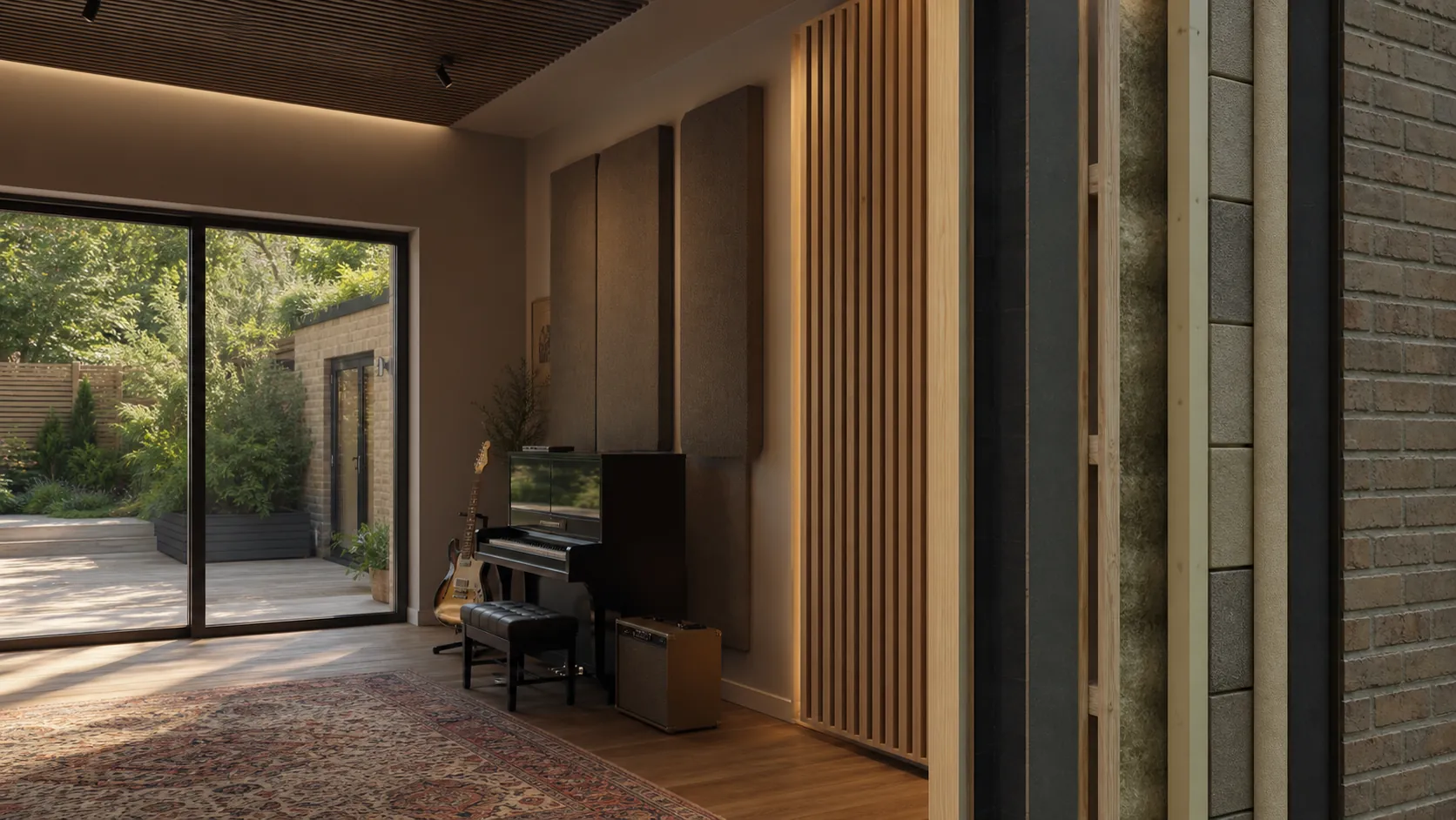
A properly designed studio treats isolation and treatment as two separate specifications rather than one combined budget line. Isolation is decided at design stage and built into the structure itself, wall build up, floor construction, door and window choice, all part of the specification the room is built to, because it cannot be meaningfully added afterward without opening the walls back up.
Treatment is usually finished after the shell is complete and can be adjusted by ear once the room actually exists, adding or repositioning panels as the space gets used and its real sound becomes clear. Acousticians who specify this kind of work professionally, whether through the Institute of Acoustics or the Association of Noise Consultants, treat the two as distinct scopes of work for exactly this reason.
What DIY Conversions Usually Get Wrong
The most common DIY mistake is buying treatment to solve an isolation problem: foam panels, egg cartons or carpet on the walls of a garden shed, expecting the neighbours to stop hearing a rehearsal. The second most common mistake is the opposite, spending the entire budget on a heavy shell and leaving nothing for treatment, then wondering why a technically well isolated room is unpleasant to actually record in.
The third, and the one that catches out otherwise careful builds, is treating every wall while ignoring how sound flanks around a structure rather than through it, a junction, a shared floor slab, a ventilation duct, that undoes isolation work elsewhere in the room. Getting the order right, isolation designed first, treatment added once the shell is finished, avoids all three of these at once.