
London GardenMusic StudiosLondon Garden Music Studios

Garden Music Studio Pods

How to read a pod's acoustic rating, why the standard behind it starts above most instruments, and when a pod is the right answer.

Discuss your studio
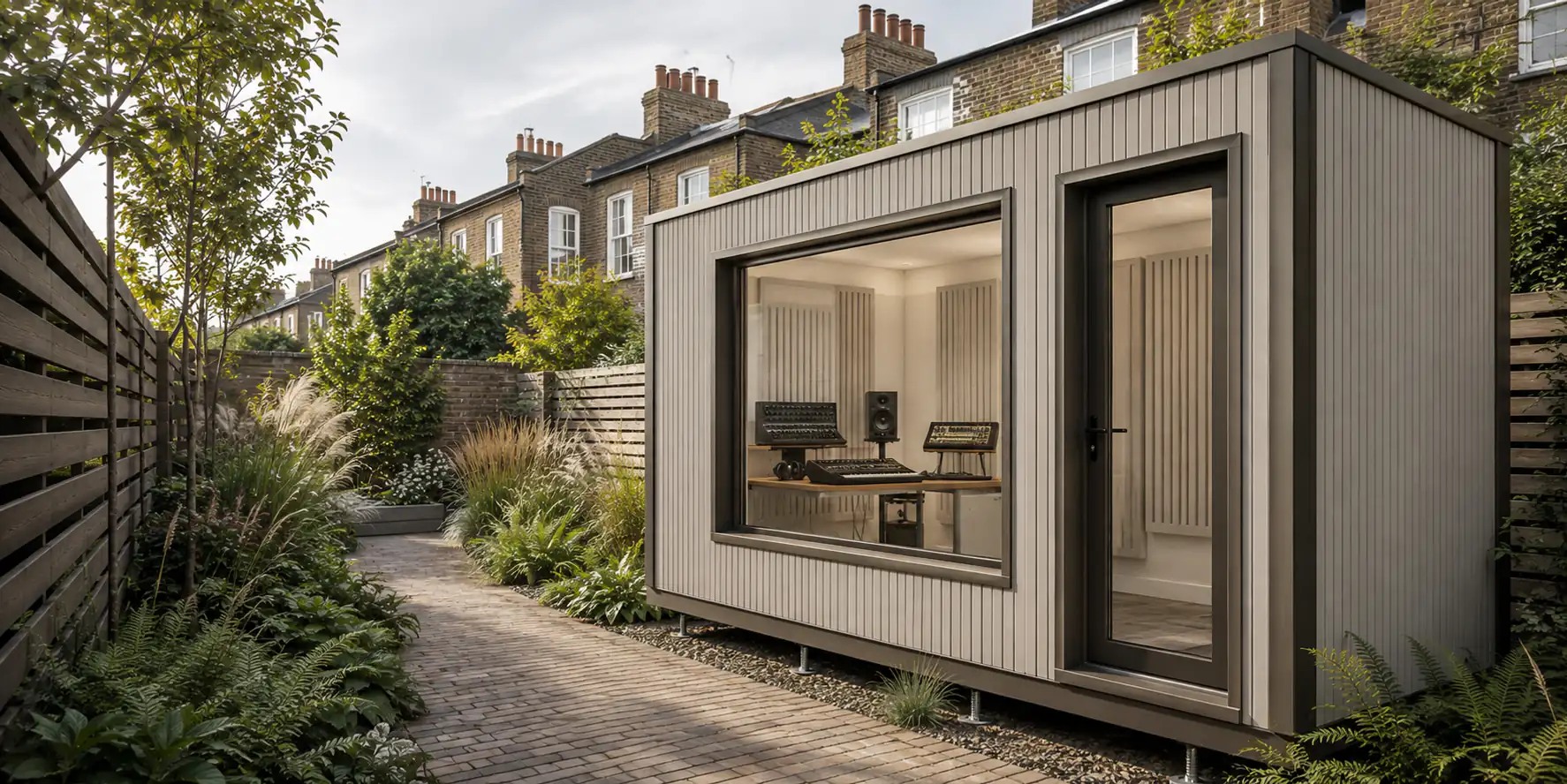
A prefabricated acoustic studio pod with an electronic music setup in a London garden

Prefabricated pods are a real product category with a real standard behind them, and they do the job they were designed for well. That job is speech privacy: an enclosure someone can take a call or hold a meeting in without the rest of the room hearing it, delivered as a unit and placed rather than built.

Where confusion arises is in reading a pod's acoustic figures as though they described sound insulation for music. They describe something else, measured a different way, over a frequency range that begins above most of the notes a musician cares about. That is not a flaw in the products, it is a mismatch between what the number means and what a buyer assumes it means.

This page explains how the rating works, what independent testing has found across the category, and where a pod is genuinely the right answer. It names no products and makes no claims about any manufacturer, because the useful thing is knowing how to read the specification you are given.

The acoustic challenge

The acoustic standard the pod category is tested to measures speech level reduction from 125 Hz upwards. Most of what makes an instrument hard to contain sits below that, so a pod's published rating can be entirely accurate and still tell you nothing about the sound you actually need to hold in.

Understand acoustic performance
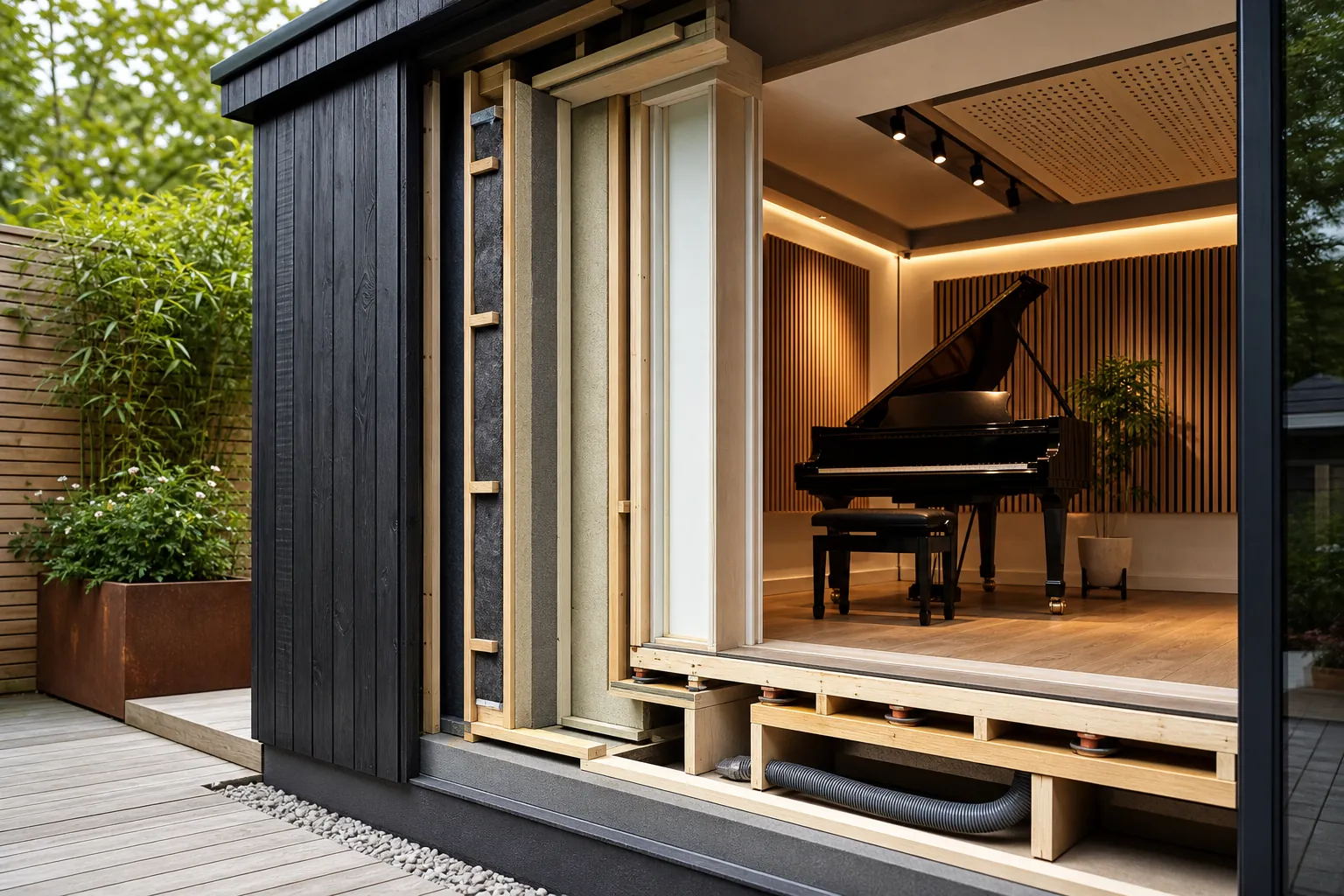
Cutaway view showing the independent inner structure of a soundproof garden studio

What the Acoustic Rating Actually Measures

The relevant standard is ISO 23351-1, which sets out a laboratory method for comparing furniture ensembles and enclosures by their ability to reduce the speech level of the person speaking inside them. It is written for products providing improved speech privacy, and it explicitly excludes individual components such as screens, storage units and wall absorbers.

The measurement runs in octave bands from 125 Hz to 8,000 Hz, and produces a single number expressing the reduction in A-weighted sound power of standard speech across that range. The published class limits are 30 dB for class A, 25 dB for class B, 20 dB for class C and 15 dB for class D, with a further class above 30 dB.

It is worth being precise about what that quantity is. It is a comparison of sound power with and without the product, for a talker inside it. It is not a partition sound reduction index of the kind used to describe a wall between two rooms, and the two are not interchangeable even though both are expressed in decibels.

Why the Rating Says Little About Music

The measurement starts at the 125 Hz octave band. A great deal of music sits below it. The lowest note on a piano is 27.5 Hz. The open low E on a four string bass is around 41 Hz, and a five string low B is around 31 Hz. Kick drum fundamentals sit roughly between 30 and 80 Hz. None of that is inside the range the rating covers, so a figure can be entirely accurate and still be silent about the part of your sound most likely to reach a neighbour.

The underlying physics compounds it. The mass law, as defined by the Acoustical Society of America, holds that doubling the mass per unit area of a panel, or doubling the frequency for a given mass, increases transmission loss by six decibels. Read that relationship downwards and a single leaf construction gives up roughly six decibels for every octave you descend, which is why low frequencies are the hardest thing any enclosure has to hold.

Decoupled constructions have a further constraint. In any double leaf build the cavity air acts as a spring between two masses, and at the mass air mass resonance the leaves move out of phase and performance drops. Published measurements put that dip typically between 60 and 100 Hz depending on cavity depth, and lighter panels with shallower cavities push it higher rather than lower, further into the range that matters musically.

What Independent Testing Found

The most useful evidence on this category is not from any manufacturer. Researchers at Turku University of Applied Sciences bought eleven commercial booths from furniture dealers and tested them all to ISO 23351-1. The measured speech level reduction ranged from 15 dB to 30 dB, which spans the entire classification scale from class D to class A.

That spread is the practical takeaway. Two products can both be described as acoustic, both be tested to the same standard, and differ by 15 dB, which is a very large difference in perceived level. The word on the brochure carries no information. The class and the measured figure do.

The test method itself is reliable, which is what makes the comparison meaningful. An eight laboratory round robin across six countries returned booth results within a reproducibility standard deviation of about 1 dB, and repeatability inside a single laboratory under 0.2 dB. If a supplier can give you a tested figure and a class, that number is worth something. If they can only give you an adjective, it is not.

Acoustic Panels Against Isolation

Acoustic panels are absorbers. Porous material traps sound energy in its structure and converts it to heat, which reduces reflections, echo and reverberation inside the space. That makes a room sound better to the person in it and is a genuine, worthwhile thing to specify.

Isolation is a different mechanism entirely, requiring dense, heavy, sealed construction to stop energy crossing a boundary. Acoustic consultants are direct that absorption should not be treated as a substitute for sound insulation, and a specification listing panel coverage is describing the first thing rather than the second.

This is why the phrase acoustic panels appears so often alongside pods, and why it is not a contradiction. The panels are doing what panels do. They are simply answering a question about how the inside sounds, not about what escapes.

Planning Treats a Pod Like Any Other Building

A common assumption is that a prefabricated or moveable unit sits outside the planning system. It does not. The permitted development rules for outbuildings draw no distinction between prefabricated and built structures: the same limits apply either way, including a maximum overall height of 2.5 metres within 2 metres of a boundary, no more than half the land around the original house covered, and nothing forward of the principal elevation.

Moveability does not settle it either. The question of whether something counts as a building for planning purposes turns on size, permanence and degree of physical attachment, and case law has established that permanence does not require a structure to be present all year round. A substantial unit that stays in a garden is generally a building whatever its method of construction.

Building Regulations run on separate thresholds: normally not required under 15 square metres without sleeping accommodation, exempt between 15 and 30 square metres only where there is no sleeping accommodation and the structure either sits at least 1 metre from any boundary or is substantially non-combustible, and always required above 30 square metres. Flats have no permitted development rights for outbuildings at all, which applies to a delivered pod exactly as it applies to a built room.

When a Pod Is the Right Answer

For speech, a pod is often exactly right. Calls, meetings, remote work, a quiet place to concentrate, spoken word at conversational level: these sit inside the range the standard measures and inside what the category is built to do, and a well specified unit with a good tested class will do the job with none of the disruption of a build.

For music the question is what you play. Quiet practice on an unamplified instrument, or work done largely on headphones, may sit comfortably within what a pod delivers. Amplified music, drums, bass, a piano or anything with real low frequency content is asking the enclosure to work in the range its rating does not describe and its construction is least suited to.

The reason we build rather than deliver is mass, decoupling and sealing at a scale a transportable unit cannot easily carry, which is what room within a room construction exists to provide. Where a moveable building genuinely is the requirement, for a rented property or a likely move, a studio designed to be dismantled and rebuilt is a different proposition from a pod and worth looking at instead.

How acoustic performance gets assessed starts from the instrument and the neighbours rather than from a product sheet, and our price ranges show where a built room lands. Tell us what you play and what you are comparing and we will give you a straight read on whether a pod covers it, including when it does.

Common questions

The practical details people usually need before deciding whether a garden studio is viable.

Are garden music studio pods soundproof?

They reduce sound rather than stop it, and the standard they are tested to measures speech level reduction rather than sound insulation. That measurement runs from 125 Hz upwards, so it does not describe performance at the low frequencies produced by a bass, a kick drum or the bottom of a piano. For speech and quiet playing a good pod performs well within its designed range.

What does an acoustic rating on a pod mean?

Under ISO 23351-1 it is the reduction in A-weighted speech sound power for someone talking inside the enclosure, measured in octave bands from 125 Hz to 8 kHz. The class limits are 30 dB for class A, 25 for B, 20 for C and 15 for D. Ask for the measured figure and the class rather than a description, because independent testing of eleven commercial booths found a spread from 15 dB to 30 dB across products.

Do acoustic panels make a pod soundproof?

No. Panels are absorbers: they reduce reflections and reverberation inside the space, which changes how it sounds to the person in it. Stopping sound crossing a boundary needs dense, heavy, sealed construction, and acoustic consultants are clear that absorption is not a substitute for insulation.

Do I need planning permission for a garden studio pod?

The same rules apply as to any outbuilding, since permitted development draws no distinction between prefabricated and built structures. That includes the 2.5 metre height limit within 2 metres of a boundary and the coverage limits for the garden. Being moveable does not exempt it, because whether something counts as a building turns on size, permanence and attachment. Flats have no permitted development rights for outbuildings at all.

Is a pod cheaper than a built garden studio?

Usually yes at purchase, and the comparison is only meaningful if both options actually solve your problem. For speech, quiet practice or headphone work a pod may be entirely sufficient and the cheaper route. For drums, amplification or anything with low frequency content, the question is not price but whether the enclosure works in the range you need, which its rating does not cover.

Make the room fit the work.

Tell us what you want to record, how you work, and what your garden allows. We’ll start with the constraints that actually shape the room.

Request an assessment