
London GardenMusic StudiosLondon Garden Music Studios

Soundproof Garden Drum Rooms

Garden drum rooms engineered around low-frequency isolation and honest expectations for London gardens.

Discuss your studio
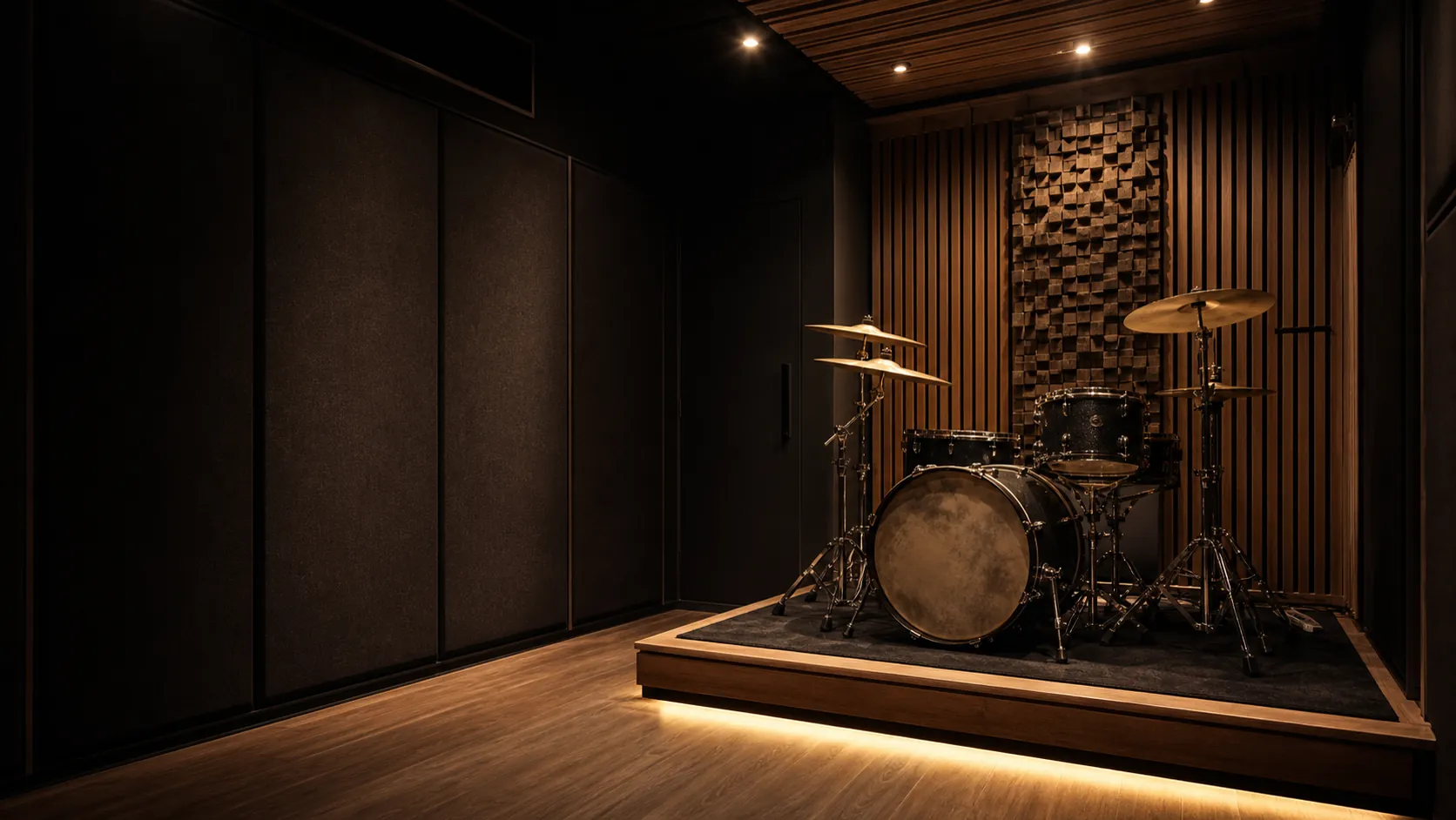
A drum kit set up inside a warm timber-lined garden practice room

A drum kit is the hardest instrument to contain in a garden building. It is not one problem but two: the sharp transient hit of stick on head, and the sustained low-frequency pressure a kick pedal and floor tom push into the ground and the frame around them. Most garden rooms are built to handle voice, guitar amps or a keyboard comfortably. A kick drum exposes the gaps in that build almost immediately.

We design and build garden drum rooms with that difference in mind from the first sketch, not as an upgrade bolted onto a standard garden room. The construction that stops a bass drum is different from the construction that stops a violin, and treating the two as the same job is how a client ends up disappointed months after the concrete has gone in.

None of that makes a garden drum room impossible. It changes what good design looks like: a floating structure that keeps the kit's vibration out of the ground and the garden fence, enough mass in the right places, and an honest conversation about what electronic pads solve and what they do not.

The acoustic challenge

Drums combine sharp transient impact with heavy low-frequency energy, and low frequency is the hardest range for any wall or floor to stop. A kick drum and floor tom will find their way through construction that comfortably handles guitar or voice.

Understand acoustic performance
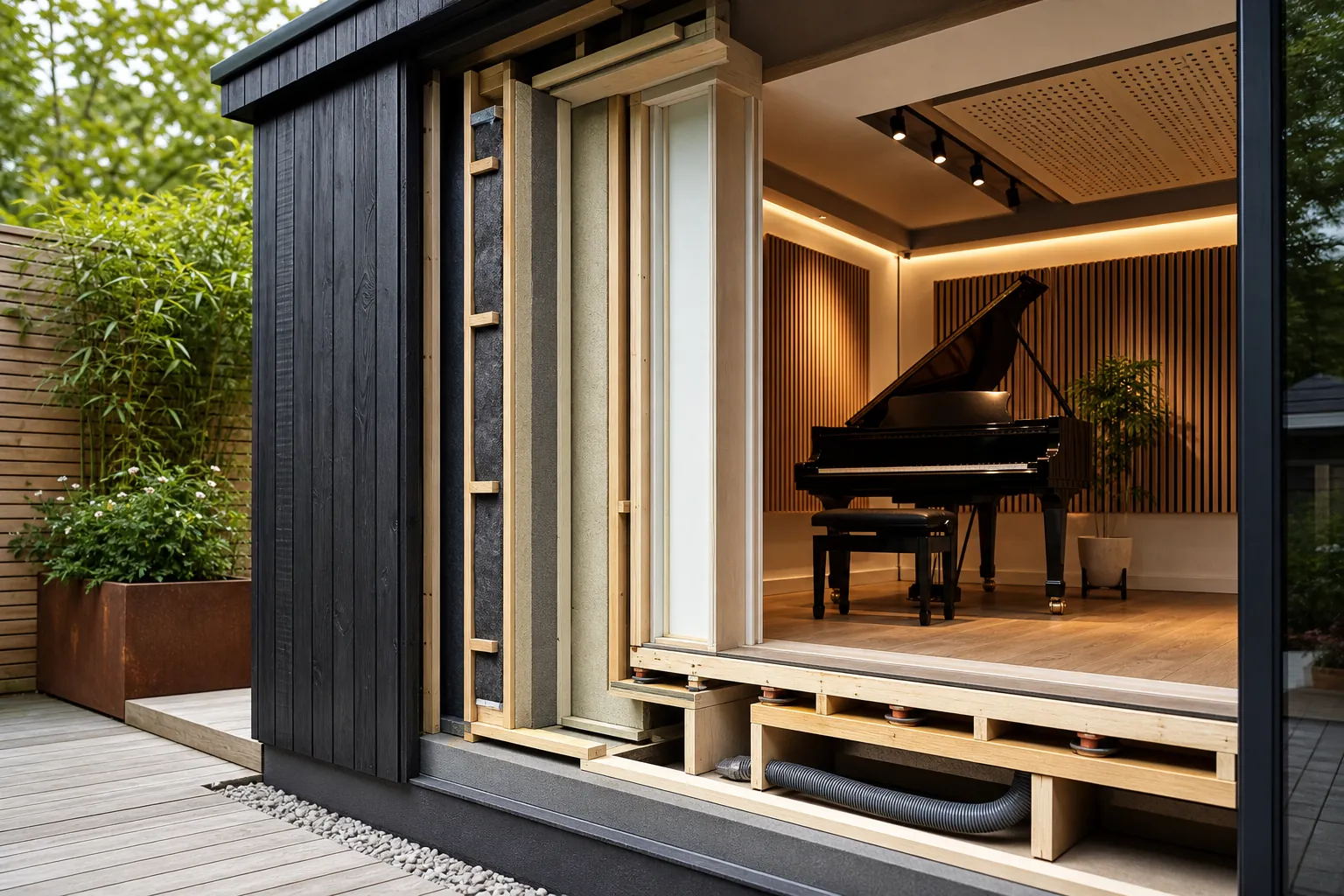
Cutaway view showing the independent inner structure of a soundproof garden studio

The Case For A Garden Drum Room

Drummers who practise at home are usually solving the same problem: somewhere to play an acoustic kit at a reasonable hour without every session becoming a negotiation with the house or the street. That covers a teenager working through grade exams, a session player who needs to stay sharp between bookings, and a parent who has given up on the idea of drums living in a spare bedroom.

A dedicated garden room also separates drumming from the rest of the house, which matters for families as much as the noise itself. A kit in a garden building does not compete for space with a sofa, does not get switched off because someone is on a call upstairs, and can be left set up exactly as the player wants it.

Some drummers ask us to design around an electronic kit instead, and we discuss that honestly rather than pushing whichever answer is easier to build. An electronic kit removes almost all of the airborne shell and cymbal noise, which solves a real problem for a lot of households. It does not remove the physical thump of a kick pedal and beater hitting a pad, or a drummer's feet and hardware transmitting vibration into a floor, so a room built for an electronic kit still needs proper isolation if the floor sits above or near a neighbour.

Sound, Frequency And Structure

The reason drums are harder than almost any other instrument comes down to frequency. Acoustic performance in any wall or floor falls as frequency drops, so the low end of a kick drum and floor tom passes through construction that would comfortably stop a snare crack or a raised voice. A wall that looks solid on paper can still let a bassline through, because mass alone struggles at low frequency, and doubling a structure's mass buys only a modest, fixed improvement, not a flat reduction across the board.

Impact is the other half of the problem. Stick on head and beater on pedal are transient hits that travel through whatever they are physically connected to, not just through the air. If the kit sits on a floor that is rigidly connected to the building's frame, or the frame is rigidly connected to the ground, that vibration becomes a flanking path that carries sound around the walls rather than through them.

Our approach is a room within a room: an inner structure that does not touch the outer shell anywhere, sitting on isolation and sealed as airtight as the design allows, because a single unsealed gap can undo a large part of what the rest of the build achieves.

Floors, Layout And Kit Specification

A single-kit drum room needs enough floor area for the kit itself, a stool with room to move, and a sensible gap to the walls so cymbals and sticks are not a hazard. Ceiling height matters more than people expect: a low ceiling brings reflective surfaces close to cymbals and makes the room sound harsh regardless of how well it is isolated.

Floors do the most work and need the most thought. A floating floor, isolated from the structure below on proper mounts, is standard for any room built around drums, and the specification of that floor build-up changes depending on whether the room sits on a solid slab, a raised timber base, or sloping ground.

If the room needs to double up for a full band rather than a solo player, the space, power and ventilation requirements change considerably, which is a different design brief covered on our garden rehearsal room page.

Terraced Streets And Realistic Expectations

Most London gardens are not large, and most London streets are terraced with houses close together on both sides. That combination is exactly where a drum room's low-frequency performance gets tested hardest, because there is less distance for the sound to lose energy before it reaches a neighbour's wall.

Permitted development still generally allows a garden outbuilding without a full planning application, subject to height and coverage limits set out by the Planning Portal, most relevantly a maximum height of 2.5 metres where the building sits within 2 metres of a boundary. Flats and maisonettes are the exception: they have no permitted development rights for outbuildings at all, so any garden building at a flat needs a full application regardless of size.

We are honest about what a realistic outcome looks like on a typical London plot. A well-built garden drum room brings practice down to a level most neighbours barely notice through a closed window at a reasonable hour. It will not make a full kit silent from the other side of a fence, and we would rather set that expectation now than after the room is built.

Cost Drivers And Your Next Step

Cost on a drum room is driven mainly by the acoustic build, not the size of the box. A floating floor and isolated inner leaf cost more per square metre than a standard garden room shell, and that gap widens with a larger kit, a taller ceiling, or a second instrument sharing the room.

Access is the other big variable. A room built through a narrow side return or over a boundary wall costs more to construct than one with clear access from the street, which is worth raising early rather than after a design is fixed.

Request a studio assessment and tell us about your kit, your garden and how close your neighbours are. We reply with an honest view of what is achievable before you commit to anything.

Common questions

The practical details people usually need before deciding whether a garden studio is viable.

Can a garden drum room really be soundproofed?

No garden room can be made completely silent from the outside. A realistic goal is a strong, noticeable reduction, usually enough that a closed-window neighbour barely notices normal daytime practice. Low frequency from the kick drum and floor tom is always the hardest part to control, however good the build.

Do I need planning permission for a garden drum room?

Often not. Most detached houses can add a garden outbuilding under permitted development, subject to height and coverage limits, provided the room is used for something incidental to living in the house rather than as a separate business. Flats and maisonettes are different: they have no permitted development rights for outbuildings, so a garden room at a flat always needs a planning application.

Is an electronic drum kit quieter than soundproofing an acoustic kit?

An electronic kit removes most of the airborne noise from shells and cymbals, which helps a lot in itself. It does not remove the impact of a kick pedal and beater, or hardware and feet transmitting vibration into the floor, so a room built around an electronic kit still benefits from proper floor isolation, especially in a first-floor flat or above a garage.

How big does a garden drum room need to be?

Enough for the kit, a stool with room to move, and a sensible gap between cymbals and the walls, which in practice means most single-kit rooms need more floor area than people expect once the acoustic build-up is accounted for. Ceiling height matters as much as floor area, since a low ceiling brings hard surfaces close to the cymbals and makes the room sound harsh.

Will neighbours still hear the kick drum through a soundproofed room?

Possibly, at a much reduced level, particularly at close range or late in the evening. Low frequency sound is the hardest energy for any wall or floor to stop, which is why a floating floor and an isolated inner structure matter more for drums than for almost any other instrument. We would rather explain that honestly at the design stage than after a room is built.

Make the room fit the work.

Tell us what you want to record, how you work, and what your garden allows. We’ll start with the constraints that actually shape the room.

Request an assessment