
London GardenMusic StudiosLondon Garden Music Studios

Vocal and Recording Booths

Why small booths colour a voice, and why the best vocal booth is usually a larger room rather than a smaller box.

Discuss your studio
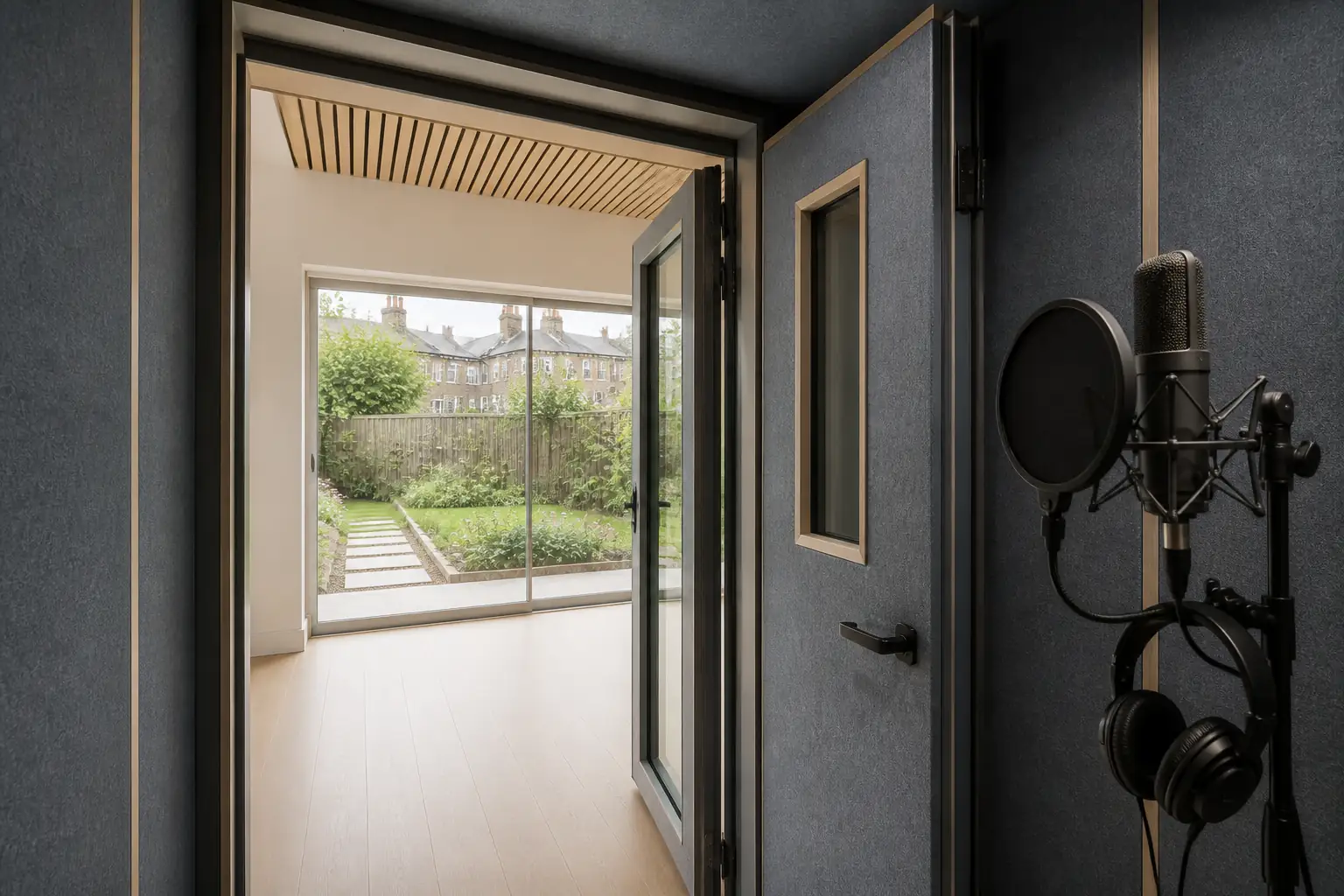
A vocal microphone inside a compact acoustic booth looking out towards a London garden

The instinct with a vocal booth is to make it as small as the person inside will tolerate, on the reasoning that a smaller box is easier to isolate and cheaper to build. Both halves of that are true, and both lead directly to the sound most home booths end up with: dull at the top, boxy through the middle, and unusable without a lot of correction afterwards.

The reason is physics rather than build quality. A room can only support standing waves down to a frequency set by its dimensions, and below that its behaviour changes character entirely. A booth is small enough that this boundary sits inside the range a human voice occupies, which is why a booth colours a voice in a way a larger room does not.

This page sets out what actually happens acoustically in a small booth, what treatment can and cannot fix, the ventilation a booth genuinely needs once someone is working in it for hours, and why the best answer is often a booth inside a larger studio rather than a booth on its own.

The acoustic challenge

A booth is small by definition, and small rooms behave badly at exactly the frequencies a voice occupies. Making the box smaller and lining it with foam makes both problems worse, so a booth has to be designed around its dimensions rather than treated after the fact.

Understand acoustic performance
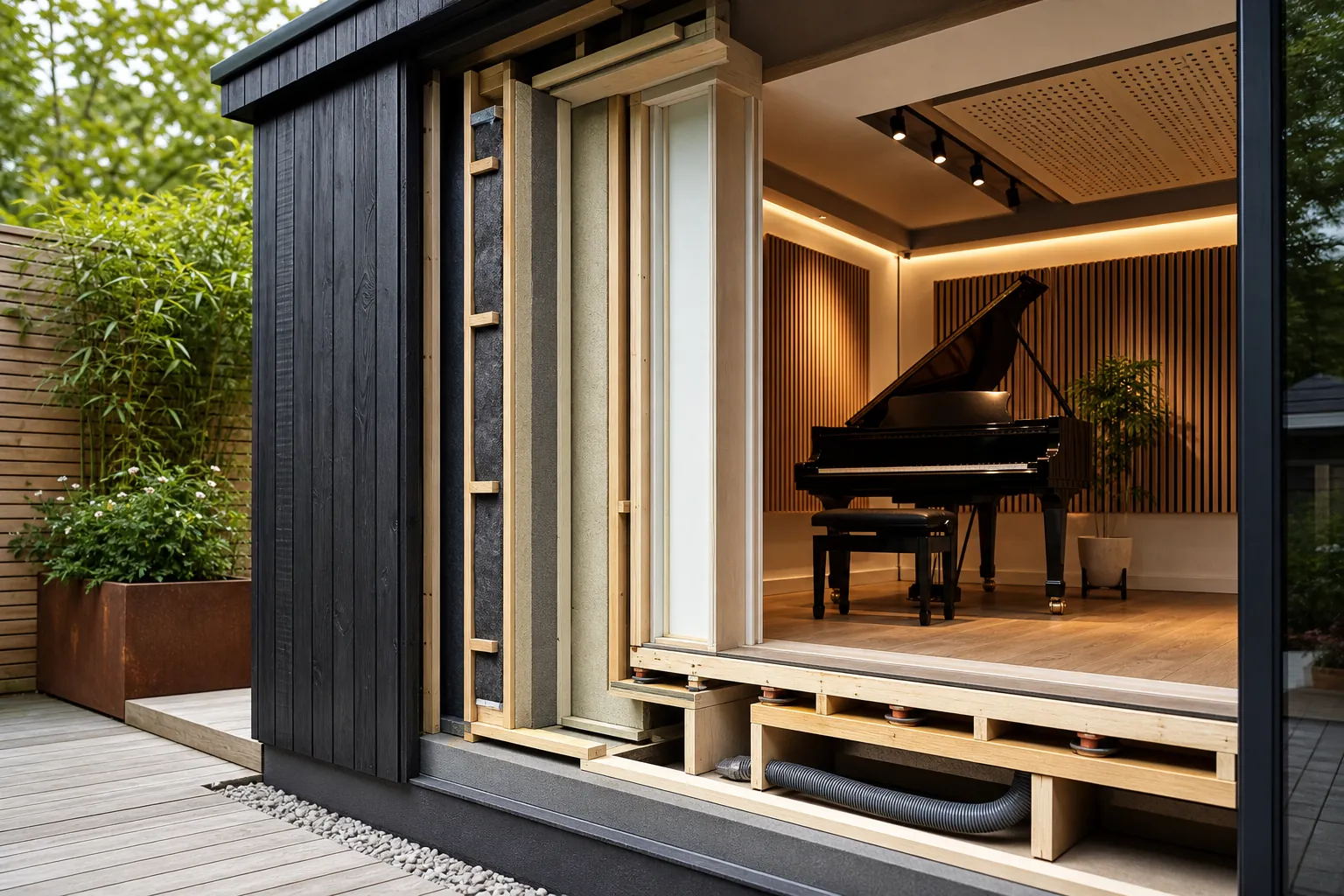
Cutaway view showing the independent inner structure of a soundproof garden studio

Why Small Booths Sound Boxy

A room's lowest supportable frequency follows from its dimensions. The first axial mode sits where a dimension equals half a wavelength, which for the speed of sound in air works out at roughly 71 Hz for a 2.4 metre ceiling, 114 Hz across a 1.5 metre width, and 143 Hz across 1.2 metres. Below the lowest mode a room cannot support a standing wave at all, and pressure becomes broadly uniform through the volume.

Set that against a voice. Fundamentals run down to around 100 Hz and lower for many speakers and singers, which places the bottom of the voice either side of a booth's lowest mode. The result is that the frequencies carrying the weight and body of the voice are in the region a small room handles worst, either bouncing between close parallel surfaces or sitting below the point where the room does anything predictable.

This is the part that cannot be fixed later. Dimensions determine where those frequencies fall, so the layout of a booth is an acoustic decision made before anything is built, not a finishing choice.

Where the Room Stops Behaving Predictably

Acousticians use a transition frequency, the Schroeder frequency, to mark where a room stops behaving as a set of individual resonances and starts behaving statistically. It is calculated from the reverberation time and the volume, and above it the modes overlap enough that the sound field can be treated as diffuse. Below it, modes are sparse and unevenly spaced, and the room imposes its own character on whatever is recorded in it.

In a large hall that transition sits low, well under anything of interest. In a booth it does not. Working the standard formula for a room of roughly seven cubic metres with a short reverberation time puts the transition somewhere in the region of 300 to 400 Hz, which is not a bass frequency at all. It is the middle of the voice.

That single figure explains most of what people dislike about small booths. A significant part of the vocal range is being reproduced in a space that is too small to treat it evenly, and no amount of absorption on the walls changes where that boundary sits.

Why Foam Alone Makes It Worse

Absorption is frequency dependent, and thin absorption only works high up. Published technical guidance puts 50mm foam as effective above roughly 2 to 3 kHz and 100mm foam down to around 1 kHz, with neither doing anything useful at the bottom of the voice. Lining a booth with foam therefore removes the top end while leaving the low and mid range exactly as resonant as before, which produces a room that is simultaneously dead and boomy.

Sound On Sound's own laboratory measurements of portable vocal booths make the pattern concrete. Screening against room reflections was effective only from about 500 Hz upwards, peaking at around 8 dB of attenuation between 800 Hz and 1 kHz. Below that, most of the devices tested actually amplified the 200 to 400 Hz region through diffraction around their edges, and one showed a 5 dB boost centred at 150 Hz alongside a comparable cut at 1 kHz.

The professional answer is depth rather than coverage. Purpose-built booths carry treatment measured in hundreds of millimetres on each surface, spaced off the wall rather than glued flat to it, because absorption only reaches low frequencies if it is thick enough and far enough from the boundary to sit where the air is actually moving. That depth is also why treating a booth properly makes it smaller, which pulls against the dimensions problem above.

Comb Filtering and the Distance to the Wall

The second colouration in a booth comes from reflections arriving very shortly after the direct sound. When a delayed copy of a signal sums with the original, the result is a comb filter, a regular pattern of peaks and cancellations across the spectrum. Over very short delays the ear does not hear this as an echo, it hears it as a change in tone.

The arithmetic is unforgiving in a small space. The first cancellation sits at the speed of sound divided by twice the extra path length, so a microphone 300mm from a hard surface, giving 600mm of extra travel, puts the first null somewhere near 290 Hz. That is in the body of the voice, and it moves as the performer moves, which is why a vocal recorded in an untreated booth can sound as though the tone shifts between takes.

Distance and absorption both address this, and a booth has limited amounts of each to give. It is the clearest single argument for a larger room where the geometry allows one.

Size Ventilation and the Person Inside

There is no published minimum size for a vocal booth, but the practical guidance in the technical press is to start with an internal floor of at least around 1.2 by 1.5 metres and to treat generously from there. The trap is that treatment consumes the space it is protecting: 150mm of absorption on opposing surfaces removes 300mm from that dimension, so a shell built to a comfortable size finishes noticeably tighter than it started.

Ventilation is the part most home booths ignore, and it is a health question rather than a comfort one. A sealed box containing one working person accumulates carbon dioxide quickly, and the Health and Safety Executive treats an average above 1500 parts per million as an indication of poor ventilation requiring action. Its guidance on fresh air supply runs to between 5 and 8 litres per second per occupant, with 10 litres per second per person cited for workplaces, and Approved Document F sets a comparable figure for offices.

Those rates have to be delivered without carrying sound in or out, which means acoustically attenuated ventilation with lined ducting and no straight path, rather than a vent through the wall. A booth used for a two-hour audiobook session without that provision becomes genuinely unpleasant, and the temptation is then to open the door between takes, which removes the isolation the booth was built for.

A Booth in the Garden Against a Booth in the House

A booth built inside a house has a flanking problem: vibration travels efficiently through joists and floor structure and bypasses the booth walls entirely, and the floor is usually where it enters. A booth in a detached garden building has no shared structure to flank through, which removes that path completely. Its own challenge is different, because lightweight construction lacks the mass to hold low frequencies, so the mass has to be designed in rather than assumed.

For anyone delivering work to a specification, the targets are published and worth designing towards. The European Broadcasting Union's guidance for listening and recording spaces sets background noise preferably at NR 10 and under no circumstances above NR 15, which is in the region of 20 dBA. Audiobook platforms commonly ask for a noise floor below minus 60 dB RMS. Those are demanding numbers, and reaching them is a function of isolation and of the ventilation running quietly, not of what is on the walls.

Our usual recommendation, where the garden allows it, is a booth as part of a larger room rather than a booth alone. A generous studio with a smaller isolated area gives you the dimensions the voice needs and the separation the recording needs, which is the reasoning behind a multi-room layout. Where the garden only takes one modest building, the honest answer is to build the largest room that fits and treat it properly, rather than to subdivide it into a box.

How we assess acoustic performance starts with what you are recording and what you have to deliver, and our price ranges cover both a single room and a room with a booth in it. Tell us what you record and where you are and we will tell you which of the two your garden can actually support. The planning position is worth checking early, because it constrains the height a treated ceiling has to fit inside.

Common questions

The practical details people usually need before deciding whether a garden studio is viable.

Why does my vocal booth sound boxy?

Because it is small. A room only supports standing waves down to a frequency set by its dimensions, which for a booth places that limit inside the range a voice occupies, and the transition where a room starts behaving predictably can sit as high as the middle of the vocal range. Lining the walls with foam removes the top end without touching this, which is what produces a sound that is dead and boomy at the same time.

How big should a vocal booth be?

Bigger than most people build. There is no published minimum, but practical guidance suggests an internal floor of at least around 1.2 by 1.5 metres before treatment, and treatment then consumes part of that, since absorption on opposing surfaces takes its depth out of the dimension twice. Where a garden allows it, a larger room with an isolated area performs better than a small dedicated box.

Does acoustic foam work in a vocal booth?

Only at the top of the range. Published guidance puts 50mm foam as useful above roughly 2 to 3 kHz and 100mm down to around 1 kHz, so neither addresses the low and mid frequencies where a small booth causes most of its problems. Effective low frequency absorption is much thicker and is spaced off the wall rather than fixed flat to it.

Does a vocal booth need ventilation?

Yes, and it is a health requirement rather than a comfort one. A sealed booth with one person in it builds up carbon dioxide quickly, and HSE guidance treats an average above 1500 parts per million as poor ventilation requiring action, with fresh air supply of between 5 and 8 litres per second per occupant. The ventilation has to be acoustically attenuated with lined ducting so it does not carry sound in or out.

What noise floor do I need for voiceover work?

It depends on the client, but the published targets are demanding. European Broadcasting Union guidance sets background noise preferably at NR 10 and never above NR 15, roughly 20 dBA, and audiobook platforms commonly require a noise floor below minus 60 dB RMS. Reaching those figures is a function of isolation from the outside world and of ventilation that runs silently.

Make the room fit the work.

Tell us what you want to record, how you work, and what your garden allows. We’ll start with the constraints that actually shape the room.

Request an assessment