
Written and reviewed by the London Garden Music Studios team. Last reviewed 3 September 2026.
This covers what actually reduces the real risk to a garden studio: physical security built into the door and frame rather than bolted onto a standard one, alarms and cameras, what home insurance policies typically expect before they pay out on a claim, and the marking and record-keeping that helps recover equipment or support a claim if the worst happens.
One advantage is already built in. A studio designed for acoustic isolation is, by construction, a genuinely hard shell: dense walls, a solid door and minimal glazing are exactly what a determined opportunist finds hardest to get through, which is not why they are specified, but is a real side benefit of building one properly.
The Door Does Double Duty
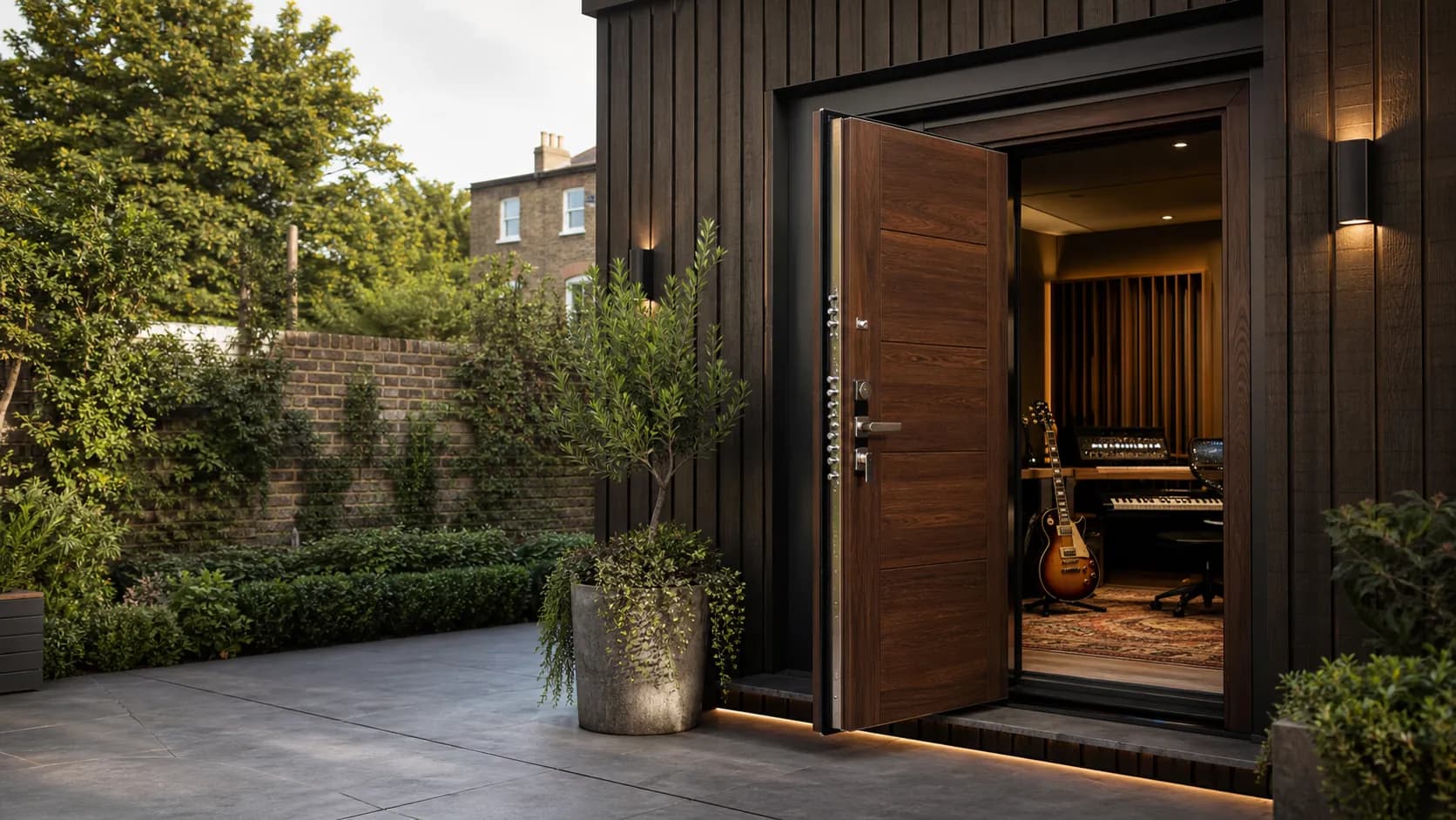
An acoustic door, heavy, solid core, gasketed to close under real compression, is specified for isolation, but the same qualities make it a genuinely strong physical barrier. A standard hollow domestic door offers almost no resistance to someone determined to get through it; a solid, properly hung acoustic door, fitted with hinge bolts so it cannot be lifted off even if the hinge side is attacked, is a different proposition entirely.
Locking hardware matters as much as the door leaf. A multi-point lock, engaging at several points up the frame rather than a single latch, resists forcing in a way a basic cylinder lock does not, and it is worth specifying to a recognised security standard rather than choosing on price alone, in the same specification conversation as the rest of the room's ironmongery. None of this needs to compromise the acoustic seal: a well-specified secure door closes as tightly for sound as it does for security.
The Case Against Windows
Every window in an acoustic wall is a compromise, acoustically and now for security as well. A studio with no window, or with a single small, high-set opening rather than a large glazed elevation, gives an intruder far less to work with, both because there is less glass to break through and because there is less visibility into what the room actually holds.
Where a window is wanted for daylight or a sightline, keeping it small, set high, and specified with laminated or toughened glazing serves both purposes at once: it is harder to break through and harder to see into from outside, which matters for a room that a passer-by might otherwise be able to survey before deciding whether it is worth the risk.
Alarms Cameras And Lighting
A standalone garden building can be fitted with its own alarm, either networked back to the house's existing system or running independently with its own monitoring, and a visible alarm box alone does some of the deterrent work before anyone ever tests the door. A camera covering the approach to the studio, rather than just the studio itself, gives useful warning and a record if anything does happen.
Lighting is the cheapest and most consistently effective measure of the three. A garden that stays dark once the house lights go off gives cover that a well-lit approach does not, consistent with police guidance on shed and outbuilding security, and a sensor light aimed at the route to the studio, not just the studio door itself, removes some of that cover without needing to be left on all night.
A monitored alarm, one that alerts a phone or a monitoring service rather than only sounding a local siren, closes a gap that matters more for a garden building than for the house itself. A siren at the end of the garden may not be heard from inside the house at all, particularly during the day when a studio is most likely to be broken into and least likely to be noticed straight away.
What Home Insurance Actually Expects
Contents kept inside a garden building are not automatically covered by a standard home insurance policy in the same way as contents inside the house, and cover for a detached outbuilding often needs to be specifically declared to the insurer rather than assumed. Policies differ meaningfully on this point, so checking the actual wording, rather than assuming a garden studio is treated the same as a shed or a garage, is worth doing before, not after, a substantial amount of equipment moves into it.
Evidence of forced entry is a common condition for a successful claim on an outbuilding, and a building left unlocked, or secured only casually, can put a claim at risk even where the loss itself is genuine. Recognised guidance on securing sheds and outbuildings exists for exactly this reason, and following it is as much about protecting a future claim as it is about preventing the loss in the first place.
Insurers have pointed to a rising trend in the value of outbuilding theft claims in their own recent public reporting, which is part of why the conditions attached to a garden building are often applied more strictly than the ones attached to the house itself. Treating the studio as a distinct risk to declare and insure properly, rather than an extension of whatever cover already applies to a shed at the bottom of the garden, reflects that reality rather than overstating it.
Marking Equipment And Keeping A Record
Visible or forensic marking on instruments, amplifiers and interfaces makes stolen equipment harder to sell on and easier to trace back if it is recovered, and a simple record of serial numbers, photographs and purchase details, kept somewhere other than inside the studio itself, turns a vague description into evidence a claim or a police report can actually use.
Photographing each item alongside something that fixes the date, and keeping a copy of that record somewhere other than on a device that normally lives in the studio, means the evidence survives even if a laptop or a phone is taken along with the instruments. None of this replaces the physical security of the room itself, but it changes the outcome if security is ever tested and beaten anyway: a well-documented, marked collection is more likely to come back, and more likely to be paid out on, than one that only exists as a mental inventory.
The Acoustic Build Is Already Doing Security Work
None of the acoustic design decisions covered elsewhere, dense wall build-ups, a properly sealed and gasketed door, minimal or absent glazing, exist for security reasons. They happen to double as some of the most effective physical security measures available for a small detached building, which is a genuine side benefit of building a proper garden recording studio rather than a standard timber garden room with a soundproofing upgrade bolted on afterward.
Treating security as part of the same design conversation as acoustics, rather than a separate checklist applied at the end, is how a studio ends up with both a locked, dense, well-lit shell and a room that performs the way it was designed to, without one being sacrificed for the other.